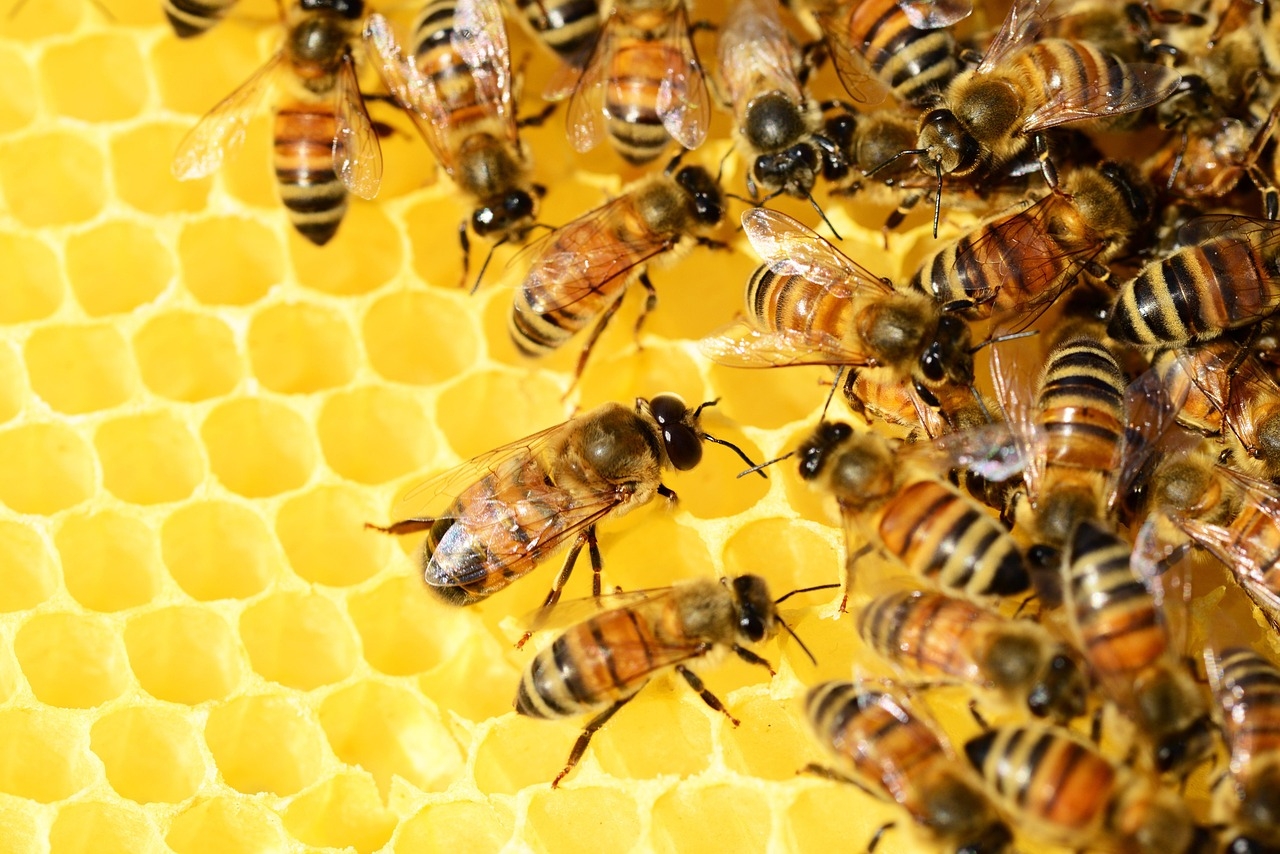
When Sherlock Holmes retired, at the age of forty-nine, as referenced by Doctor Watson in the story His Final Bow it seems clear that Holmes had not fully retired, as he was at that time engaged in espionage against Germany as a spy and double agent, and it is unlikely that His Final Bow was actually his last.
There were whispers of war everywhere and the Great Game was in full swing. That Holmes might continue to turn his formidable talents to espionage at the request of the crown and his spymaster brother Mycroft is not difficult to imagine.
Beekeeping upon the South Downs would have provided an excellent cover story and later on a fascinating subject for study.
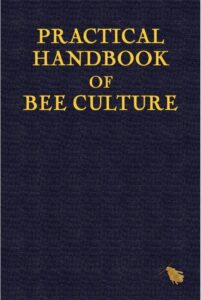
‘“Exactly, Watson. Here is the fruit of my leisured ease, the magnum opus of latter years!” He picked up the volume from the table and read out the whole title, Practical Handbook of Bee Culture, with Some Observations upon the Segregation of the Queen.’” — from His Final Bow
Of the three books I read to learn more about the Great Detective and his bees, his own book, Practical Handbook Of Bee Culture with Some Observations upon the Segregation of the Queen, was the most informative in respect to the art of beekeeping. Written as a kind of journal over a period of ten years — from 1903 through 1912 — it chronicles not only Holmes’s progress and advancement as a bee man, but also chronicles his marriage to Mrs. Hudson (Fiona), as well as his interest in and adaptation to village life and the energetic social life they engaged in. This sounds like rather boring, every day humdrum stuff, but it is actually quite fascinating! Holmes makes mention of a few of his undocumented cases, most notably his involvement in the Ripper investigation but breezes over the details as if they held little interest for him. He also tells Watson of an encounter with the remaining members of the Moriarty family who make an attempt on his life. Holmes later speculates that the Professor’s daughter, Emma, driven by her cold and all encompassing hatred, might strike at him again in the future and that he could not fault her for doing so.
“Alone I did it. Behold, the fruit of the pensive nights and laborious days when I watched the little working gangs as I once watched the criminal world of London.’” — from His Final Bow
The chemistry of honey production, the nutritional and medicinal value of royal jelly, propolis, and the properties and applications of bee venom would all have been of interest to Holmes. And it is not difficult to see how the culture of the hive with all its activity centered around one predominant being who was the source and the recipient of all its effort would remind him of Professor Moriarty’s highly organized and complex criminal network.
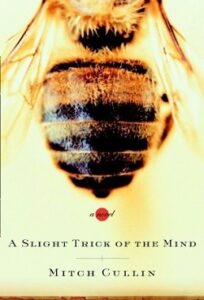
In Mitch Cullin’s A Slight Trick of the Mind, a story that takes place in 1947, we encounter a 93-year-old Holmes who is still tending his bees but who is struggling with an aging mind that no longer operates with precision and clarity. There is little beekeeping knowledge in this chronicle though we do learn that Holmes is passing his knowledge of the hive on to a young protégé, Roger, who his tragically killed in a wasp attack while attempting to thwart the wasps’ assault on Holmes’s bees. A Slight Trick of the Mind follows four significant events in Holmes’s life, his aforementioned relationship with Roger, a trip to Japan to visit a gentleman, Mr. Umezaki, with an alleged interest in the restorative properties of royal jelly and the prickly ash plant, but who is concealing an ulterior motive, Holmes’s personal journey into the experience of feeling and acting on emotion, and The Glass Armonicist: The Case of Mrs. Ann Keller of Fortis Grove, that Holmes takes on and that became his final investigation and influenced his decision to retire and become an apiarist.
Mr. Holmes is the film adaptation of A Slight Trick of the Mind that reinterprets and clarifies some aspects and events in the book. The film version also presents a significantly different, less grim conclusion to the story.
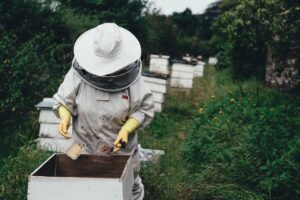
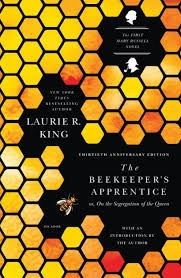
In Laurie King’s The Beekeeper’s Apprentice there is not much mention of beekeeping practices except for an intriguing encounter at the beginning of the story where a 15-year-old Mary Russell encounters Sherlock Holmes in 1915 on the Sussex Downs for the first time where she observes that he has marked a number of bees with blue and red dots of paint and is documenting the directions of their flight in order to discover the location of a wild hive in order to replenish his own diminished colonies. The story primarily follows Russell and Holmes from their first encounter, through Russell’s apprenticeship as a fledgling detective, the cases they undertake as they adjust to working together, and finally a terrifying game of cat and mouse with a cunning and dangerous opponent that nearly costs them their lives, but ultimately seals their relationship and their partnership.
There is quite a wealth of bee wisdom and bee folklore in Sussex, England and Holmes must surely have encountered it through his acquaintance with local bee men. He says as much in his book.
One of these practices, chronicled in the film, is “telling the bees.” In England, and other parts of Britain, bees are treated as part of the household and are informed of births, marriages and deaths in the family. This custom has been a tradition throughout England for centuries.
Another custom is: “Bees, according to a prevalent Sussex notion, will not do well unless gold be paid for them, hence the old saying:
(c. 1871. Sussex Archaeological Collections Relating to the History and Antiquities of the County. Page 65)
In many cultures around the world bees are believed to be sacred/holy and even the carriers of human souls.
Not Holmes related, but may be of interest to those wanting to know more about ancient bee wisdom:
The Shamanic Way of the Bee: Ancient Wisdom and Healing Practices of the Bee Masters by Simon Buxton (Book)
Hymns from the Hive (Sacred Drumming and the Songs of Bees) by Layne Redmond and Tadeu Mascarenhas (CD)