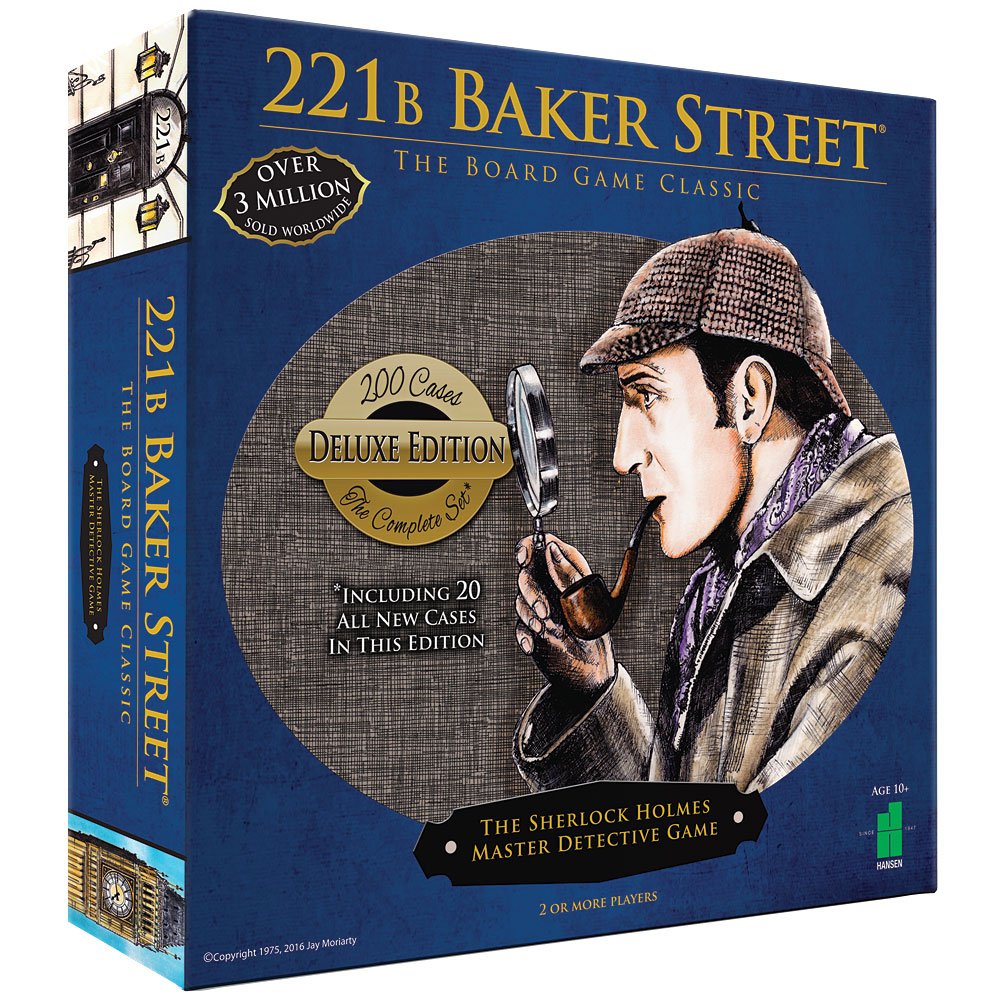
If you’re someone who loves Sherlock Holmes AND board games, 221 B Baker Street is the perfect game for you. In this article, I’ll explain the differences between the British and American versions of 221 B Baker Street, give a brief overview of how the game is played, look at some pros and cons, give some playing tips, some suggestions for enhancing your game play, and look at some variations including a solo player variant.
Overview of the 221 B Baker Street Board Game
There are two slightly different versions of the game: The Gibson version (UK) and Hansen version (US). I own the Hansen Deluxe Edition, so that’s the one I’ll refer to in this article unless otherwise indicated. The primary differences, as I understand it, between the Gibson (UK) version and the Hansen (US) version is a different game board layout and the number of and selections of cases. The Gibson 2014 Edition includes seventy-five cases and the Hansen Deluxe Edition includes 200 cases. There is some crossover with the Gibson version including some, but not all of the Hansen cases. Americans playing the British version may run into a bit of trouble with clues that only a Brit would suss. Also, the Gibson (UK) version uses Sherlock busts in different colors as game pieces, while the Hansen (US) version uses different colored pawns. For a comprehensive description of differences and lists of cases for each version search for 221B Baker Street game on the Gameboard Geeks website.
Both the Hansen Version and the Gibson version of 221 B Baker Street are available from third party sellers on Amazon or buy directly from Hansen Games or Gibson Games.
“The 221 B Baker Street game plays like a hybrid of Clue and Consulting Detective: More challenging than Clue, less challenging than Consulting Detective.”
A Brief Description of Basic Game Play
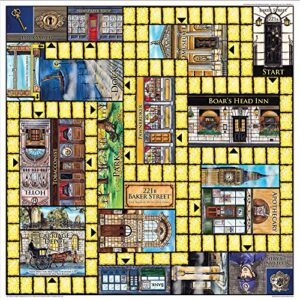
Set up the game board. Distribute Key Cards, Scotland Yard Cards (see rules for use), and Clue Sheets. One player reads one of the case cards aloud, then players begin the game by placing their game pieces on the board inside the 221 B Baker Street square. Each player rolls a dice (d6) to determine who will move first. Players take turns rolling dice (d6) and moving their game pieces around the board. There are fourteen locations such as Scotland Yard, the Carriage Depot, and the Boar’s Head Inn that you can visit to discover clues. When you arrive at a location, look on the back of the case card for the location number to look up the clue. Make a note of the clue and your assessment of it on your Clue Sheet. Make sure you tick off all the locations where you have searched for clues.
When you believe you have solved the case, you must continue to take your turns rolling the dice and moving your game piece on the board until you return to 221 B Baker Street before you can announce your solution. If your solution is correct, you win the game. If your solution is incorrect you lose and you are out of the game. The other players then continue to take their turns and gather clues.
If this is your first encounter with the 221 B Baker Street board game or you prefer to learn by observation, this video by Mac the Madcap Gamer provides an in-depth look at basic game play.
Tips for Playing 221B Baker Street
Play close attention to the information presented on the case cards. Locations may be mentioned or implied where a significant clue can be found and you’ll want to attempt to get there first.
Objects may be mentioned that indicate a location. Likewise, other information leading to clues may be discovered if you “read between the lines.”
Invest in precision dice. Precision dice are perfectly balanced with sharp edges, ensuring a fair and random roll.
Use a dice roller or a “roulette” dice spinner or dice cups and roll on a felt surface or other surface rather than rolling on the game board. You’ll have a less restricted roll and you’ll be less likely to disrupt other players’ pieces.
When playing cooperatively, have one player act as “Mycroft” (a game master) reading the case card aloud, keeping track of locations visited, reading the clues aloud, recording the assessment(s) after discussion, keeping players focused, and announcing the solution.
Consider using a white board for cooperative play. Recall Holmes’s use of a chalk board in “The Adventure of the Dancing Men.”
Like a true consulting detective, make notes on what you learn from each case you tackle.
221B Baker Street Game Advantages
There are four ways to play: Competitively, Cooperatively, Teams, and Solo.
Massive Replay-ability (Hansen Deluxe has 200 cases).
Variations available (from Gameboard Geeks) or create your own.
221B Baker Street Game Disadvantages
It seems logical that if certain locations and/or objects are mentioned on a case card that a significant clue would be found within. Often true, but not always.
When playing competitively, the game is not “social” enough. In other words, in order to focus on solving the crime, players have to spend a lot of time reading, note taking, and thinking, rather than socializing with each other.
Playing 221B Baker Street Cooperatively
Cooperative play, all players working together to solve the mystery, eliminates a number of situations that can occasionally be problematic. Playing cooperatively allows more interaction between players. Highly competitive players aggressively bent on winning (you know the type) can be off-putting, even intimidating to the casual or more laid back player. Cooperative play eliminates this conflict in temperament and style of play. Because the players are working together the need for Scotland Yard cards (that lock other players out of a location) and Key cards (you need one to unlock a location locked by another player) is also eliminated. Seriously though, you won’t miss them if you spice up your game play with variants and accessories.
221B Baker Street Game Variants
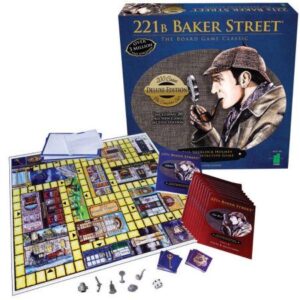
The Hansom Cab Variant: This is a diceless variant that introduces new hansom cab cards to aid movement.
The Solitaire Variant: This variant introduces a smidgen of RPG (role playing game) action into the game — adding three constables and a criminal — such as rolling for results or consequences or reactions. Tip: Use two different colors of d6 dice when rolling for Constable movement and direction.
Green d6 = number of moves
Gold d6 = direction of movement
You can further refine variants to suit your tastes and needs or design your own variants.
To access the game variants mentioned above plus more variants, set up an account at Gameboard Geeks. It’s free and allows you to gain access not only to the variants, but more game tips, and player discussions about the 221 B Baker Street board game. You can also add your own variants and cases.

Spice Up Your 221B Baker Street Game Play
Include music (sound tracks from the Sherlock Holmes movies and television series, music of the Victorian Age, solo violin, or whatever you prefer).
Replace standard game pieces with miniature figures.
Supply players with Sherlock Holmes “accessories” such as special pencils, notebooks, buttons.
Make it an event: We do an English dinner and game night with family and friends. Themes can be from a canon story or Victorian times, etc. Finish off the evening or afternoon with a favorite Holmes film, television episode, radio theater, or podcast.
Issue a challenge: Create/design/write your own 221 B Baker Street case to play and solve.
“It is of the highest importance in the art of detection to be able to recognize, out of a number of facts, which are incidental and which are vital.” — Sherlock Holmes